
Security Insights & Technical Guidance
Designing an Integrated Security Command Centre: Systems, People and Operational Resilience
A security command centre is not defined by the number of screens on the wall. Its effectiveness depends on whether the people inside can recognize an event, understand its significance, coordinate a proportionate response and preserve an accurate record. Technology should support that decision cycle rather than overwhelm operators with disconnected displays and alerts.
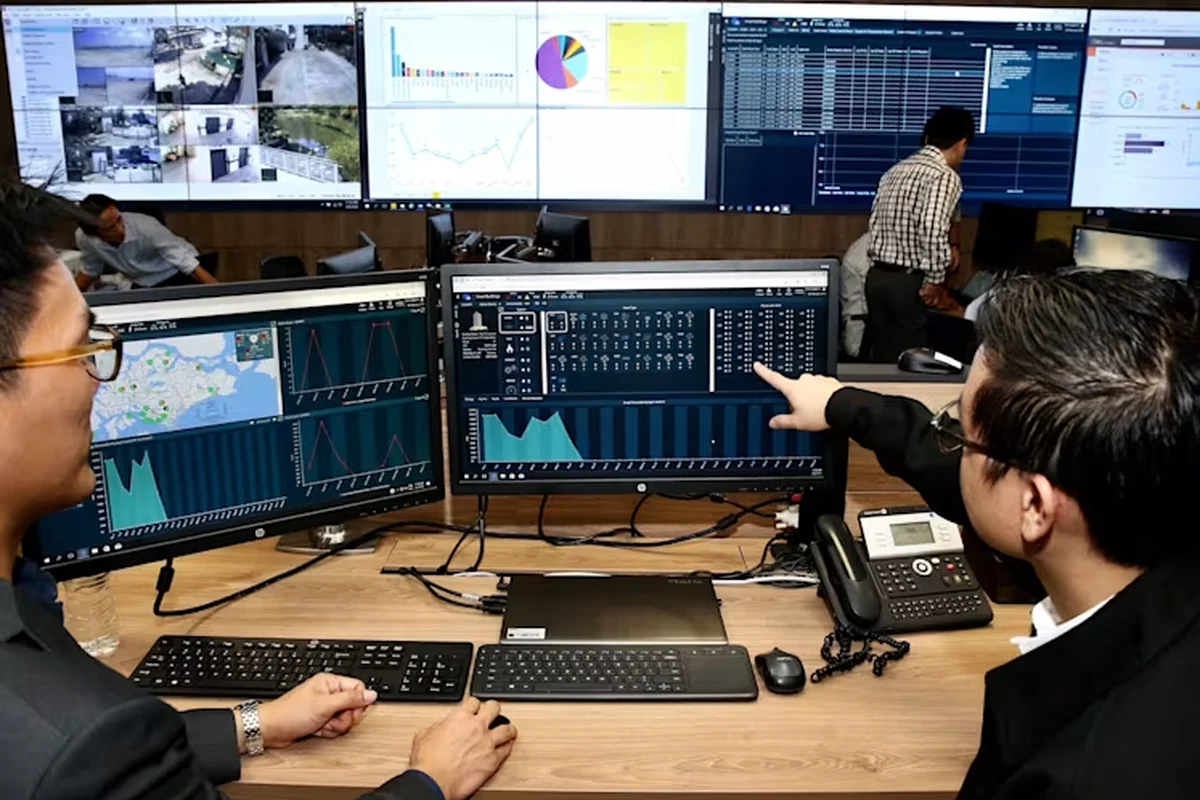
A security command centre is not defined by the number of screens on the wall. Its effectiveness depends on whether the people inside can recognize an event, understand its significance, coordinate a proportionate response and preserve an accurate record. Technology should support that decision cycle rather than overwhelm operators with disconnected displays and alerts.
A successful project begins with the organization’s operating concept. A single-site control room monitoring a commercial tower may require a different staffing model, system architecture and resilience level from a multi-site command centre coordinating distributed industrial facilities. Those differences should shape the design before equipment is specified.
1. Define the operational requirement
The operational requirement should identify sites monitored, operating hours, incident categories, stakeholder roles, response resources and critical decisions. It should describe the expected journey from event detection to verification, dispatch, escalation, closure and post-event review. Risk assessments and business-continuity priorities help identify which functions are essential.
Define users beyond the control-room operator: site managers, responding guards, technical maintainers, emergency coordinators and executives may need different information and communications channels. Clarify who can issue instructions and how the command centre interacts with local teams during a serious incident.
2. Translate workflows into functional specifications
An effective specification addresses capabilities such as event receipt, alarm filtering, event correlation, live and recorded video access, operator acknowledgement, communications, audit trails and report generation. “Integrate all systems” is too vague to tender or test. Each required interface should identify source data, event type, latency expectation where appropriate, permitted operator actions and failure handling.
Create representative use cases: a security alert from a remote site, a visitor issue at a busy building, or loss of a critical monitoring connection. Each use case should have an expected sequence of actions. This allows vendors to propose a coherent solution and provides a basis for acceptance tests.
3. CCTV and Video Management Systems (VMS)
A VMS provides functions such as live viewing, recorded playback, user privileges, export, camera health status and event-related video association. Design decisions include camera quantities, image requirements, recording retention, network capacity, storage design, time synchronization and access governance. Storage calculations should use documented assumptions about resolution, frame rates, compression and retention, not arbitrary estimates.
The VMS should support the operator’s real tasks. A command centre with hundreds of cameras should not assume operators can continuously watch every feed. Event-driven views, appropriate layouts and clear priorities are often more useful than a large permanent grid of images.
4. PSIM and security management integration
Physical Security Information Management (PSIM) or integrated management platforms may correlate events from CCTV, access control, intrusion detection, perimeter alarms and other systems. Integration value depends on the actual interfaces and operating procedures. Not every site needs a PSIM layer, and a product described as “integrated” may support only limited functions without additional development.
Assess the required data exchange, system ownership, cyber and network dependencies, administrative privileges, user training and maintenance model. Integration should have explicit test cases, for example displaying a relevant camera when an approved alarm event occurs and logging the operator’s acknowledgement and subsequent actions.
5. Design the alarm workflow
Alarm flooding undermines situational awareness. Establish categories based on consequence and urgency, routing rules, acknowledged ownership, escalation time expectations and procedures for persistent faults. A controlled workflow can distinguish informational health messages from security events needing verification and immediate response.
Operators should have the context needed to act: which facility, which asset, what event, recent related activity, who is available to respond and the agreed escalation route. The system should record actions without forcing excessive administration during critical incidents.
Functional architecture — illustrative, not a fixed product design
CCTV / VMS ───────┐
Access Control ───┼──> Integration / Event Layer ──> Operator Workstations
Intrusion Alarms ─┤                 │                    │
Perimeter Sensors ┤                 │                    ├──> Incident Log
System Health ────┘                 │                    └──> Escalation / Dispatch
                                   └──> Reporting & Audit Trail
Each source and connection should be validated for availability, permissions, data protection and recovery behavior. An integration diagram is not proof that products interoperate.
6. Room layout, ergonomics and human factors
Operator performance is affected by sightlines, viewing distances, acoustics, lighting, temperature, workstation spacing, communications and interruptions. The choice and placement of video walls should follow information needs rather than serve as decoration. Routine operational information may be better placed on task-specific workstations, with shared displays reserved for common situational awareness.
The design should consider shift handover, fatigue management, supervisor oversight, confidential conversations, maintenance access and accessibility. Physical room security, visitor access and protection of equipment and communications are part of the design scope.
7. Communications and incident coordination
The command centre may rely on radios, telephony, messaging, dispatch platforms or site incident systems. Define primary and alternative means, contact directories, response authority and handover processes. The operator must be able to identify whom to contact, how to confirm receipt and what to do when the normal communication route fails.
Procedures should include incident classification, escalation, stakeholder notifications, record preservation and post-event review. Security technology cannot compensate for unclear decision authority.
8. Resilience and continuity requirements
Assess credible equipment and service failures: loss of mains power, degraded network links, VMS storage faults, server disruption, local site disconnection or loss of the control room itself. Decide which functions must continue and for how long. This may lead to UPS, diverse network routes, redundant servers, local site fallback procedures or alternative monitoring arrangements, subject to cost and criticality.
The design should distinguish technical redundancy from operational resilience. A duplicate server is of limited value if no trained operator can manage incidents during a control-room outage.
9. From specifications to FAT, SAT and acceptance
Requirements should be converted into testable acceptance criteria. Factory Acceptance Testing (FAT) may validate a configured solution before deployment; Site Acceptance Testing (SAT) should assess the installed environment; integrated scenario testing checks whether the complete workflow performs as intended. The Acceptance Test Procedure (ATP) should document prerequisites, tests, expected outcomes, evidence and defect management.
Command-centre design checklist
| Design workstream | Essential question | Typical evidence |
|---|---|---|
| Operating model | Who monitors, decides and responds? | Concept of operations, staffing and escalation model |
| Video | What images and history are needed for specific tasks? | VMS requirements, camera and storage schedule |
| Integration | Which events must be correlated or displayed? | Interface matrix and use-case tests |
| Alarm management | Which events warrant response? | Priority matrix and operator SOPs |
| Human factors | Can staff work effectively over shifts? | Layouts, ergonomics and workflow reviews |
| Resilience | What must function during a major failure? | Dependency assessment and recovery procedures |
| Acceptance | How will performance be demonstrated? | FAT/SAT/ATP records and defect closeout |
10. Handover, training and lifecycle management
Deliverables should include final configurations, drawings, interface schedules, system inventories, operating manuals, recovery procedures, operator training, maintenance responsibilities and warranty information. Periodic exercises and management reporting should evaluate whether the operating concept remains effective as sites, threats and systems change.
Independent design advisory should not be confused with providing a 24/7 monitoring service. A consultant may define and review a command centre without operating it. Website language must accurately reflect the contracted service.
Common command-centre design errors
A command centre can underperform even when individual systems are technically capable. Common errors include selecting screens or software before defining the operating model; connecting systems without agreeing the events, priorities and operator actions that matter; treating a video wall as a substitute for usable workstation design; assuming an interface exists without testing the actual configuration; and designing for normal operations without considering power, network, staffing or room-loss scenarios.
Another error is treating handover as the end of the work. Operator training, escalation procedures, configuration control, maintenance ownership, exercises and defect closeout all affect whether the control room will deliver the intended response over time. Requirements and acceptance evidence should make those responsibilities visible.
Frequently asked questions
Does every command centre need PSIM?
No. The decision should reflect system complexity, event volumes, operator needs, integration feasibility and lifecycle cost.
Is a video wall necessary?
Not always. The objective is effective situational awareness. Some operating models are better served by focused operator workstations and selective shared displays.
What is the difference between FAT and SAT?
FAT generally assesses configured functions in a controlled environment before site deployment; SAT verifies installed functions on site. Contract definitions govern the precise testing scope.
References and further reading
The UK National Protective Security Authority (NPSA) sets out an operational-requirements approach that can help turn user needs into testable technical specifications: https://www.npsa.gov.uk/security-best-practices/protective-security-risk-management-psrm/operational-requirements. This is UK technical guidance, not Singapore law or a statement of Singapore requirements; apply jurisdiction-specific requirements separately.
For intruder-alarm interfaces in Singapore, the current SS 558:2024 title and scope can be checked with Singapore Standards: https://www.singaporestandardseshop.sg/Product/SSPdtDetail/f776ee3e-3acb-4a89-942b-c369d253da3d. It is an intruder-alarm-systems code of practice, including signalling and central-alarm-monitoring-station-related provisions; it is not a universal command-centre or control-room standard and does not define every installation or protection requirement.
Next step: Explore Security Technology & Digital Transformation and Security Project Management.
Speak with LORIN
Discuss a Security Requirement
Discuss how this guidance applies to a defined facility, development or security decision.